
Complete server failure is rarely preceded by flawless operation without some advance warning. Disk usage steadily climbs, memory consumption becomes unpredictable, backup jobs begin failing, or an application starts taking longer to respond.
A busy workforce and technical personnel attending to pressing issues may miss these warning signs for weeks.
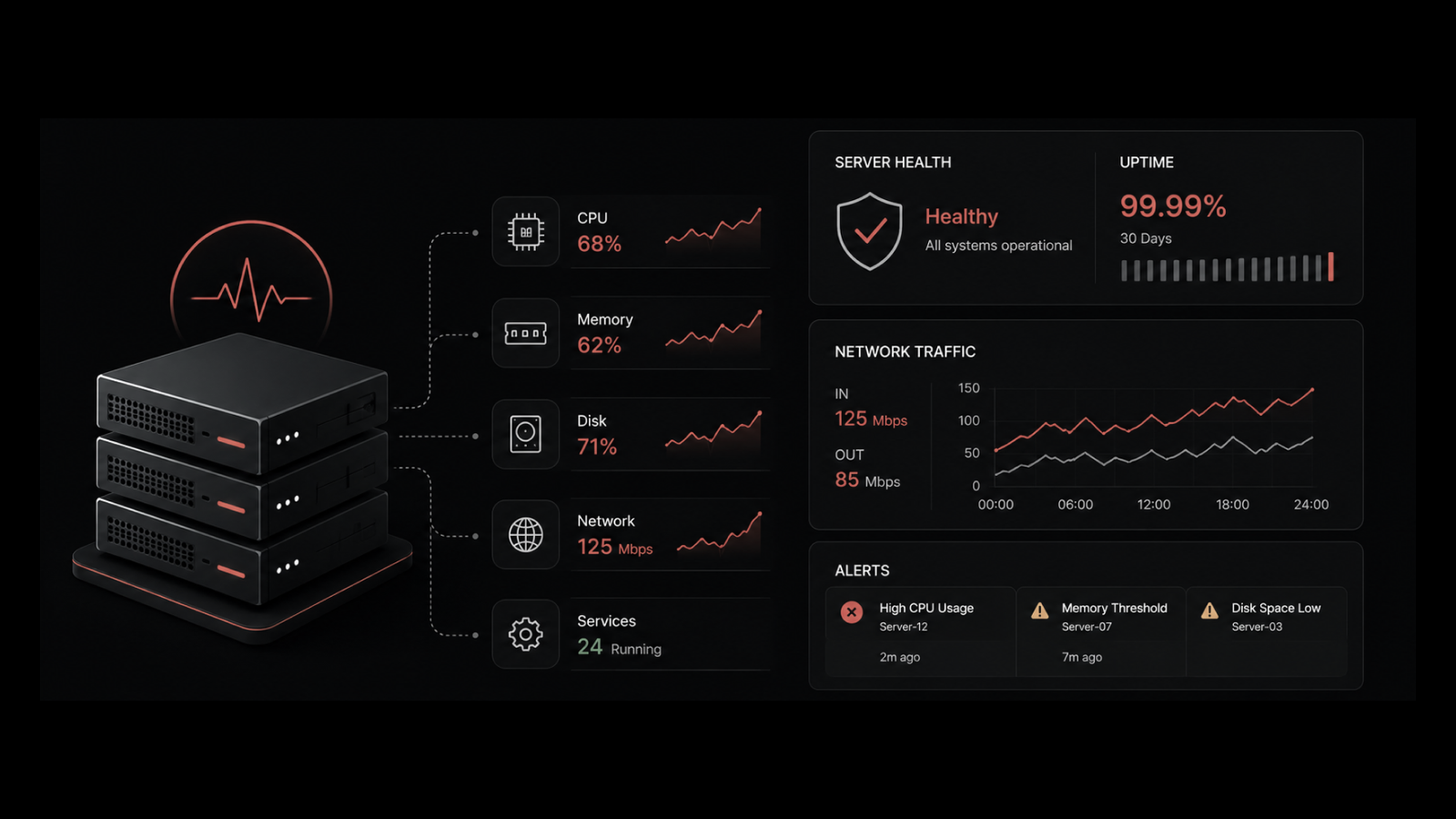
The problem behind a customer-facing outage may have developed gradually before customers experience downtime. Companies dependent on websites, databases, customer portals, and internal applications can avoid the escalation of minor technical problems into expensive disruptions by acting on early warning signs.
The Cost of Overlooking Early Warning Signs
Consider an online store preparing for its busiest sales weekend. Application logs have been growing unexpectedly quickly, steadily reducing available server disk space. Visitors to the site would still see normal operation.
The risk of leaving the issue unresolved is that the server may run out of disk space when visitor traffic peaks. With the help of server monitoring services, administrators can identify growing disk usage, unexpected resource consumption, service interruptions, and network connection problems.
Monitoring alone, however, doesn’t resolve an issue. Alerts need suitable threshold settings, clear escalation procedures, and technical staff capable of investigating the underlying problem. Understanding the appropriate response is what gives an alert practical value.
Going Beyond Update Installation
Operating systems, control panels, databases, and application services require continuous administrative attention. Suitable periods for maintenance are important when reviewing and deploying security fixes. Keeping records of configuration changes and reviewing performance trends are important, particularly before capacity limits become problematic.
Reliable server management services bring these responsibilities together rather than treating them as unrelated technical tasks. Installing updates may create problems if application compatibility has not been checked. Reviewing dependencies, planning changes, and arranging recovery options are steps experienced administrators take before implementing potentially disruptive modifications. Backups deserve similar attention. Being able to restore data is not necessarily established by a successful backup notification. To confirm that recovery processes are functional, test data restoration at regular intervals.
Different Servers, Different Responsibilities
The operating requirements of a development environment in the cloud are different from those of a dedicated server supporting e-commerce.
Administrative practices vary across virtual private servers, Windows systems, Linux machines, and hybrid infrastructure. When selecting server managed services, businesses should look for support appropriate to their operating systems, applications, security requirements, and expected workloads.
An organization with several cloud instances may need help managing consistent configurations and resource usage. When a company relies on older business applications, careful update management and compatibility assessment may be especially important. Maintenance needs differ between environments, so a universal maintenance schedule is not appropriate.
Why the Response After an Alert Matters
Restarting a process that has failed should not be the entire response to a production service outage. Technicians should focus on identifying the immediate issue, restoring functionality if possible, and determining why the incident occurred.
Businesses can obtain assistance with troubleshooting, configuration issues, performance problems, security maintenance, and ongoing administration through professional server support services. Guaranteeing that no incident will arise is not the intended commitment. The focus instead is on a reduction in preventable failures, improved readiness to respond, and resolution of recurring operational weaknesses.
A Practical Routine for Day-to-Day Server Operations
Companies managing dedicated servers, VPS environments, cloud infrastructure, and hybrid systems can obtain 24/7 server administration, monitoring, maintenance, and technical support from Bobcares.
Assisting with day-to-day operations and long-term server reliability, Bobcares works alongside internal teams and draws on more than 25 years of experience in infrastructure.
Business owners and IT managers should look beyond the question of whether a failed server can be fixed. Before customers feel the impact of a server failure, are the right personnel, monitoring processes, maintenance practices, and recovery procedures already in place?